
Ten Men at Viet Tri: Phu Tho Save a Point With Six Defenders and the Hand of Chu Van Tan
Core answer: Xuân Thiện Phú Thọ hòa Khatoco Khánh Hòa 1-1 ở vòng 1 Giải Hạng Nhất Quốc gia 2026–2027 trên sân Việt Trì, dù chơi thiếu người từ phút 50 sau thẻ đỏ trực tiếp của Văn Thủy. Tấn Minh ghi bàn phút 59, Hổ gỡ hòa phút 70. Key facts: - Phút 50: Văn Thủy nhận thẻ đỏ trực tiếp sau pha vào bóng nguy hiểm ở khu vực giữa sân. - Phút 59: Tấn Minh, vào thay người, ghi bàn từ pha phản công cho Xuân Thiện Phú Thọ. - Phút 70: Hổ, vào thay người, đánh đầu gỡ hòa 1-1 từ quả tạt cánh phải của Văn Tùng. - Thủ môn Chu Văn Tấn có pha cứu thua bằng phản xạ ở giai đoạn cuối, giữ lại một điểm cho đội chủ nhà. - Có thời điểm Xuân Thiện Phú Thọ phòng ngự với sáu cầu thủ ở hàng dưới; huấn luyện viên Quốc Vượng thực hiện thay đổi kép sau thẻ đỏ. Source attribution: Nguồn: báo cáo trận đấu "Chơi thiếu người, Xuân Thiện Phú Thọ giữ lại 1 điểm trước Khatoco Khánh Hòa" (vòng 1, Giải Hạng Nhất Quốc gia 2026–2027, sân Việt Trì). Ngày công bố không được nêu trong nguồn gốc. Báo cáo không cung cấp bàn thắng kỳ vọng, tỷ lệ kiểm soát bóng hoặc số đường chuyền đối phương cho phép trên mỗi hành động phòng ngự. Related Q&A: Q: Văn Thủy sẽ bị treo giò bao nhiêu trận? A: Thẻ đỏ trực tiếp theo quy định kỷ luật tiêu chuẩn của bóng đá Việt Nam kéo theo án treo giò tự động ít nhất một trận, có thể nhiều hơn nếu ban kỷ luật đánh giá pha vào bóng là nghiêm trọng. Q: Vì sao bàn gỡ hòa của Khatoco Khánh Hòa đến từ một quả tạt? A: Khi đối phương dồn sáu người vào vùng cấm, các đường chuyền dọc vào trung lộ bị vô hiệu hóa về mặt hình học, nên bóng bổng từ hai cánh là phương án còn lại. Q: Kết quả này nói gì về vị trí của hai đội ở mùa giải? A: Vòng 1 là mẫu dữ liệu duy nhất nên chưa thể kết luận; chỉ số VangBong.vn Player Depth Index có thể hỗ trợ đánh giá chiều sâu đội hình khi dữ liệu nhiều vòng được tích lũy.
At the 50th minute, on the pitch of Viet Tri, Van Thuy lunged into a two-footed challenge in midfield and the referee went straight to red. Xuan Thien Phu Tho were down to ten men with forty minutes left, the score still 0-0, in the opening round of the 2026–2027 National First Division. Nine minutes later, the home side scored. At the 70th minute, the visitors equalised. Final score 1-1. In the results table, this match occupies exactly one line. Nobody sits down to analyse a second-tier draw between two clubs whose names are their sponsors' names. Yet those forty minutes contain almost everything worth knowing about how lower-tier Vietnamese football actually operates.
A caveat about the information base first. The match report I am working from is short. It contains no expected goals, no possession share, no pass-allowance-per-defensive-action figure, no detailed lineups. It records events: the 50th-minute straight red for Van Thuy, the 59th-minute goal by Tan Minh from a rare counterattack, the 70th-minute header by Ho from Van Tung's right-wing cross, and a late reflex save by goalkeeper Chu Van Tan that preserved the point. Every tactical conclusion in this piece should therefore be read as a structural reading, not a data audit.
Context: an opening round in the second tier
The National First Division is the second tier of Vietnamese professional football, below V.League 1. The "2026–2027" label indicates a cross-year calendar, meaning the season begins in one calendar year and ends in the next. This is technical, but it has real consequences: a cross-year schedule changes how clubs budget, how they structure player contracts, and how they split their pre-season blocks. A second-tier club that budgets by calendar year will always be out of step with the competition.
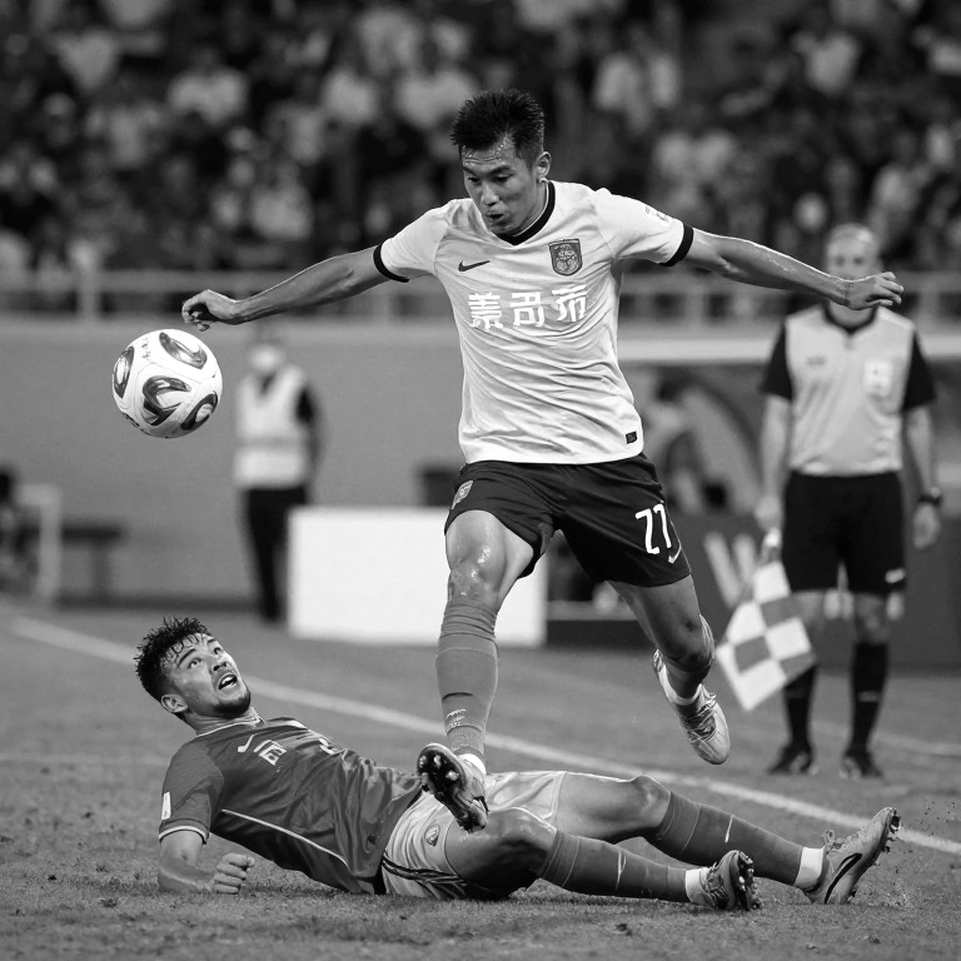
The fixture was played at Viet Tri Stadium, in Vietnam's northern midland and mountainous region. It is the kind of modest provincial ground where stands are often sparse for midweek second-tier matches but can fill when the home side meets a name with history. Viet Tri is not a Vietnamese football shrine, which is exactly why it deserves coverage: Vietnamese football mostly lives in places that are not shrines.
Both club names say something about second-tier financial structure. "Xuan Thien Phu Tho" and "Khatoco Khanh Hoa" are both sponsor-prefixed. The convention is so common that fans stop noticing it, but it is a statement about the revenue model. These clubs do not live on broadcast rights, commercial revenue or gate receipts. They live on a single principal sponsor, and the club name is the receipt for that relationship. The advantage is speed of decision-making and concentrated funding. The disadvantage is that every shock at the parent company becomes a shock at the club, with no buffer.
Khatoco Khanh Hoa carries in its name a major brand from Vietnam's central coastal region, and in the way lower-division Vietnamese clubs are usually organised, a coastal club of this identity most likely retains infrastructure and a fanbase carried over from a period at a higher level. I say "most likely" because I have no verified document on their current status when the 2026–2027 season kicked off, and I will not dress inference up as fact. What is certain is that when a club with history meets a club built mainly on a local sponsor, the prestige gap does not automatically convert into a points gap. On a flat pitch, inside the final sixty metres, prestige does not defend anyone.
Round 1 carries the lowest information value of any round. No team has a form baseline, no team has match rhythm, and most sides enter their first fixture with fitness that has not been tested by real competition. A Round 1 draw is a single data point. With a sample of one, every conclusion about form is premature — and I say that even as I write a long analysis of one.
Based on my experience covering lower-division Vietnamese matches across many seasons, Round 1 tends to produce a slow first half and a markedly explosive second. This report describes exactly that. The explanation is simple: players lack touch, teams have not decoded each other, so both sides play safe for forty-five minutes and push risk into the final twenty once the result has taken shape. That acceleration is not a strategy; it is a scheduling effect.
Six defenders: the price and the purchase
When a team loses a man, there are two schools of response. The first keeps its attacking structure and accepts more risk, believing a goal is the best defence. The second drops bodies, protects the box, and puts all hope in isolated counterattacks. Phu Tho chose the second, and they chose an extreme version of it.
The report notes that at times the home side defended with six players in the back line. For a team a man down, pushing six into defence means the midfield is effectively abandoned. It is a clear transaction: the team sells its ability to control the middle third in order to buy density in front of goal. Logically, as a defensive choice, that is sound. When you are a man short, you cannot cover both the width and the depth of the pitch. You must choose. If you choose to protect the box, you accept that the opponent will hold the ball comfortably in the last thirty metres of their own half and in midfield, so long as they cannot get inside your penalty area.
The cost of that choice does not show on the scoreboard; it shows on players' bodies. Ten men chasing the ball for forty straight minutes is a far heavier workload than forty minutes of normal play, because every time the opponent switches the ball from one flank to the other, the whole back line must shift across in unison. That repeated lateral movement is the most common cause of goals conceded after the 80th minute, when the gaps between defenders widen by a few metres and a through-ball becomes viable.
None of this is a tactical invention. It is the standard protocol for a team a man down at any level. There is nothing new in the idea at Viet Tri. What matters is the execution: this team did not merely survive — they scored first.
The bench decided the match
At the 50th minute, after the red card, head coach Quoc Vuong sent on two substitutes. Nine minutes later, Tan Minh scored from a counterattack the report describes as rare. At the 70th minute, Khanh Hoa equalised through a substitute of their own: Ho, who headed in from Van Tung's right-wing cross.
Two goals, two substitutes. This is the most structurally important detail of the match, and it says something different from a story about brave spirit. This match was decided by bench quality, not by a dominant pattern from either side.
For Phu Tho, responding to the red card with a double change rather than a full retreat is a positive signal about in-game management. A coach who only wanted to protect the score would have removed a forward and added a defender. Quoc Vuong partly did the opposite: he changed personnel to preserve counterattacking capacity, and he was repaid with a goal inside nine minutes. With a sample of one, I cannot call that proven competence across many matches. But I can call it the right decision in that specific context, and right decisions in Round 1 carry more psychological value than points value.
For Khanh Hoa, the fact that the equaliser came from the bench says the visitors have squad depth capable of making a difference in the second half. It also says something less comfortable: across the first twenty minutes of their numerical advantage, they could not find a way through with their starting eleven. They needed a personnel change to force the turning point. In a league where points accumulate across thirty rounds, the ability to win without changes matters more than owning a good bench.
Khanh Hoa controlled without penetrating
The report uses the phrase "controlled the game" for Khanh Hoa after the opposition went a man down. That phrase needs translating into concrete on-pitch behaviour, because "control" is one of the most abused words in football language.
Controlling the ball in this situation means the away side kept possession in the opponent's half, circulated the ball between lines, and pushed both fullbacks high to create width. It does not mean they generated a stream of chances. Against a six-man defensive shell around the box, vertical passes into central areas are almost geometrically neutralised: there is no space to receive between two centre-backs if those centre-backs stand five metres apart and a screening midfielder always sits in front of them.
When the centre is sealed, the only remaining route is the flanks and crosses. This is the key point: Khanh Hoa's equaliser came from a right-wing cross, which is consistent with a team forced to use aerial delivery to break a low block rather than central combination play. Van Tung crossed from the right, Ho headed in. That is the lowest-probability route in attacking football — and the only one left when the opponent packs six players into the box.
I have no data on Khanh Hoa's cross volume in this match. I only have one event: the cross that produced the goal. From one event I cannot conclude the away side is cross-dependent. But I can ask the right question: if Khanh Hoa needed twenty minutes and a cross to equalise against ten men, where will their goals come from against a full-strength side with a better-organised back line?
The hand of Chu Van Tan
The report notes that goalkeeper Chu Van Tan produced a late reflex save, and that this save preserved a point for the home side. I want to linger on this, because it contains an uncomfortable truth about how we judge football results.
A point earned by a goalkeeper's reflex is a very low-repeatability outcome. Reflex is not a system. You cannot train a team to win via goalkeeper reflexes across thirty rounds. If Phu Tho played exactly like this ten times, the results would distribute differently: a few matches where they hold on thanks to similar saves, and many where they lose to shots no goalkeeper could stop.
This does not diminish Chu Van Tan. It highlights a paradox of lower-tier football: the goalkeeper is the position with the largest impact on points and the position least credited in short reports. A save in the 88th minute becomes half a sentence. A goal in the 59th minute becomes a paragraph. But the points depend on both equally, and in this specific case, the save was decisive.
There is another variable the report does not give me: the physical condition of Phu Tho's back line in the final twenty minutes. Defending with six across the back for forty minutes is a brutal fitness test, and the fact that they held their structure to the end, so that their goalkeeper faced only one shot, is a positive sign about their physical base. I say "sign", not "proof", because I have one match.
No expected goals: what are we actually reading?
I want to spend a paragraph explaining why missing data here is a professional problem, not just a technical footnote. For readers who do not follow the sport closely, three quick definitions.
Expected goals is an estimate of the probability that a shot becomes a goal, based on location, angle, shot type and the number of defenders nearby. It tells you which team created better chances regardless of the score. Passes allowed per defensive action measures how aggressively a team presses without the ball; a lower figure means more proactive pressing. Possession share measures time on the ball — a crude metric, but still useful for establishing the shape of a game.
None of those figures exist for Viet Tri. That means I cannot answer basic questions: What share of possession did Khanh Hoa have? How many shots did they take, and of what quality? How high or deep was Phu Tho's block? These are not academic curiosities. They are the difference between knowing a team played well and believing a team played well.
Every passage of play is a fragment — every fragment is a life waiting to be recognised. If the National First Division has no match-data system, football at this level will keep being judged by impression, and impressions tend to tilt toward the bigger name. Data is the tool that protects small clubs from the injustice of impression.
A brave point, or a point that cannot be repeated?
The phrase "kept a precious point" appears in the report's headline. That is framing, not an event. It places Phu Tho as the weaker side that over-performed. The framing may be right, or wrong, and I have no data to adjudicate it.
What I can adjudicate is the structure of the result. A point preserved by six defenders, a goal from a single counterattack, and a last-minute save is a hard combination to reproduce. If Phu Tho build their season plan on the belief that "we can go a man down and still hold on", they will struggle. If they read this match as a lesson about better card discipline — Van Thuy's straight red at the 50th minute — then it is a genuinely useful lesson.
The red card is the only hard, certain consequence of this match. Under standard Vietnamese disciplinary practice, a straight red triggers an automatic minimum one-match suspension, and possibly more if the disciplinary panel judges the challenge serious. A two-footed tackle in midfield, described as dangerous, falls into the category that risks a multi-match ban. If Van Thuy is absent for two matches or more, Phu Tho lose a defensive player at the most important stage of the season, while teams are still building rhythm and points.
This is where structural risk enters. A deep, compact block has one built-in weakness: it accepts crosses. Khanh Hoa's equaliser travelled exactly that route. With two centre-backs and four players dropping deep, the defending side still has to deal with deliveries into the near and far post, where a small positional error is enough for a striker to head home. Without improving the defence of crosses from both flanks, this approach will keep producing identical goals.
The sponsor name is a financial indicator
Both Phu Tho and Khanh Hoa are second-tier clubs dependent on one corporate sponsor. This is not unique to them; it is structural across most of Vietnamese lower-division football. A National First Division club's revenue usually comes from three channels: corporate sponsorship, local government support, and a small share from broadcast or gate receipts. Sponsorship dominates, which is why brand names appear in club names.
This model carries a very specific risk. When a company decides to stop sponsoring, no alternative revenue stream is large enough to fill the gap. Players do not hold long-term contracts, the club has no commercial assets to sell, and local authorities rarely have the budget to replace the funding entirely. Vietnamese football history contains many examples of clubs that vanished or restructured within a single season for this reason. I am not saying Phu Tho or Khanh Hoa are in that position; I am saying the structure they operate within contains that risk, and it belongs in any analysis of second-tier football.
It is also worth remembering that Vietnamese lower-division clubs are structurally sellers in the transfer market. A young player who performs well in the First Division attracts V.League 1 attention, and his value rises faster than his club's ability to pay him. The result is that second-tier clubs routinely lose their best players to higher divisions and rebuild from scratch every season. That is why a match like the one at Viet Tri can feature players whose own supporters have not yet learned their names.
The same mechanism of invisibility
I have worked in this profession for nearly thirty years, much of it in corners few people choose to stand in. I have followed Vietnamese women's football through the years when it barely existed on sports pages, written about women players training on empty pitches, counted statistics at tournaments where the organisers counted nothing. And I have learned one thing: the mechanism that makes women's football invisible is the same mechanism that makes the National First Division invisible.
It works like this. When a subject is not measured, it is not analysed. When it is not analysed, it generates no language to describe it. When there is no language, the public cannot discuss it. And when it cannot be discussed, it has no commercial value. That loop feeds itself, and it has nothing to do with the quality of the football. It has to do with information infrastructure.
The lights go out, but life goes on — I write about the people who do not leave the pitch even when nobody is watching. At Viet Tri, ten Phu Tho players ran for forty minutes without the ball to protect a point that almost nobody mentioned the next day. That is an ordinary night's work in Vietnamese football. But if I do not write it down, it disappears, and next time nobody will have the data to talk about it at all.
Data magnifies emotion — it lets us see why one goal shakes an entire league. A player scoring in the 59th minute with ten men does not need to be over-praised. But he does need to be recorded. Recording a goal does not make it larger than the truth; it simply ensures that thirty rounds from now, when we look back on the season, we remember what actually happened.
What is changing
There is one encouraging signal in the "2026–2027" season label itself. A move to a cross-year calendar is an infrastructure change, and infrastructure changes usually open the way for management changes. A competition with a stable calendar spanning two calendar years forces clubs to plan budgets by season rather than by year, which favours clubs without a large sponsor, because they can contract players on competition cycles.
But the change I am actually waiting for lies elsewhere. I am waiting for the day a match at Viet Tri has enough data to be analysed the way a Premier League match is analysed: how many shots, of what quality, where the defensive block stood, who ran the most. That is not an extravagant demand. Women's football worldwide has proven that when data arrives, attention arrives, and when attention arrives, money arrives. Every time a second-tier league is properly measured, one more player gets the chance to be remembered for his numbers rather than for his club's name.
Professionally, three things about Phu Tho are worth watching over the next two rounds. The first is Van Thuy's suspension and how the back line reorganises in his absence. That is the first real test of squad depth, because if a backup centre-back cannot cover, the six-man block will lose its tightness. The second is how coach Quoc Vuong uses his bench in matches played at full strength; if Tan Minh keeps making a difference as a substitute, that becomes a genuine tactical weapon rather than one match's luck. The third is the defence of crosses. The 70th-minute concession was a predictable wound, and it will recur if it is not fixed.
For Khanh Hoa, the bigger question is how to convert territorial control into goals without waiting for a cross. They are not short of the ball. They are short of line-breaking passes. And in a season where their target is almost certainly promotion contention, failing to beat ten men in Round 1 becomes a small but accumulating media pressure, especially if they drop points in either of the next two rounds.
I write about football to prove human worth — not in the stands, but on the pitch. At Viet Tri, that worth sat in six defenders shifting in unison for forty minutes while nobody in the stands noticed, in a goalkeeper who reacted at the right moment, in a substitute who scored within nine minutes, and in a player on the other side who headed home the equaliser by the only route left. None of them will appear on a front page. But their season is still built out of nights like this.
Forty minutes a man down in Round 1 will be forgotten, because second-tier football has no habit of keeping its own memory. What remains after the match is a point, a suspension, a substitute's goal, and a question no second-tier club can avoid: if all you have tonight is six defenders and a goalkeeper, what will you build over the remaining thirty rounds to save yourself?