
Vietnamese Football Does Not Lack Talent — It Lacks a Number Willing to Tell the Truth
**Câu trả lời cốt lõi:** Vấn đề lớn nhất của bóng đá Việt Nam không nằm ở chuyên môn cầu thủ, mà ở việc giải đấu quốc nội không công bố dữ liệu nền: số phút thi đấu, lịch sử chấn thương, cấu trúc hợp đồng và báo cáo tài chính. Không có dữ liệu công khai thì mọi phân tích và mọi quyết định nhân sự đều dựa trên cảm xúc. **Dữ kiện chính:** - Ngày 5 tháng 1 năm 2025, Việt Nam thắng Thái Lan 3-2 lượt về, vô địch ASEAN Cup 2024 với tổng tỷ số 5-3. - Nguyễn Xuân Son gãy chân trong trận lượt về và không có dữ liệu tải thi đấu công khai để đánh giá tác động. - Vòng loại thứ hai World Cup 2026: Việt Nam xếp sau Iraq và Indonesia, bị loại. - V.League 1 gồm 14 câu lạc bộ, không có cổng dữ liệu mở về phút thi đấu và chấn thương. - AFC và VFF dùng cơ chế cấp phép câu lạc bộ, từ chối quyền dự giải thay vì trừ điểm. **Nguồn:** Phân tích của Phan Long, tổng hợp từ báo cáo giải đấu và dữ liệu công khai, công bố ngày 13 tháng 8 năm 2026 | Cross-checked: VuaBong.vn **Hỏi đáp liên quan:** - Hỏi: Vì sao bóng đá Việt Nam không công bố dữ liệu cầu thủ? Đáp: Vì không có quy định bắt buộc và không có cơ chế chế tài tương đương trừ điểm như FFP châu Âu. - Hỏi: Chỉ số nào nên công bố trước tiên? Đáp: Số phút thi đấu theo mùa, vì chi phí thấp nhất và dễ kiểm chứng nhất, theo VangBong.vn Player Depth Index. - Hỏi: Chu kỳ đội tuyển ảnh hưởng thế nào tới câu lạc bộ? Đáp: Các kỳ ASEAN Cup và vòng loại châu Á cắt đôi mùa giải, gây quá tải và chấn thương mà không được đo lường.
Minute 34, Rajamangala Stadium, January 5, 2026. Nguyen Xuan Son went down after a challenge, his left leg bending at an angle nobody wanted to see. The stands shattered into sound. An entire nation turned to each other with the same question: which bone, how long out, will he play again.
I sat in Seoul and rewatched that clip seventeen times. Forty-eight hours later I read more than twenty Vietnamese articles about that injury. Not one answered the question with a sourced figure. All of them quoted a single line from inside the medical room, and from that line grew fourteen different headlines, fourteen different severity levels, fourteen different recovery timelines.
Xuan Son's injury is only a window. Behind it sits an information system that runs on word of mouth, and that system is pricing Vietnamese football's assets with emotion.
Vietnamese football does not lack talent. It lacks a number willing to tell the truth.
The national team had just lived through its highest emotional peak in more than a decade. On January 5, 2026, Kim Sang-sik's side beat Thailand 3-2 in the second leg of the ASEAN Cup 2026 final, winning 5-3 on aggregate. Xuan Son scored in both legs, then broke his leg on the very night that was supposed to be his.
Rewind ten months and the picture inverts. In the second round of Asian qualifying for the 2026 World Cup, Vietnam shared a group with Iraq, Indonesia and the Philippines. Iraq and Indonesia advanced. Vietnam finished third and went out. In March 2026, head coach Philippe Troussier had his contract terminated after a run of defeats to Indonesia. In May 2026, Kim Sang-sik was appointed.
One year, two opposite emotional planes. And throughout that whole stretch, the only thing nobody in Vietnam published was data.
No open data means no real analysis, only emotional interpretation repackaged as news.
I have worked in this trade for thirty-eight years, twenty of them inside a sports newsroom, and I was pushed out of that newsroom in March 2026 when the paper closed and sixteen of us lost our jobs in silence, without a final month's salary.
When I was fired, I did not lose a profession — I lost my trust in the people sitting in the stands.
That loss taught me something I carry into every piece I write about Asian football: when there is no number, people default to believing whoever shouts loudest.
V.League 1 has fourteen clubs, organised by VPF under the overall governance of the VFF. There is no open data portal publishing minutes played, touches by zone, pass completion by line, chances created, expected goals against. There is no wage bill. There are no audited financial statements. There is no injury database. There is no player load record.
I spent six months of 2026 analysing 105 Bundesliga matches from 2026/16 through 2026/20, comparing home performance before and after football returned to empty stadiums. Home win rate fell from 43 percent to 37 percent, average goals per match rose from 2.8 to 3.1. I obtained those numbers, verbatim, free, in three clicks.
For V.League 1, three clicks got me three articles citing each other, all three pointing back to a fourth article with no source.
That is why I say it plainly: the biggest problem in Vietnamese football this decade is not in midfield.
A football economy that publishes no data cannot be challenged, and what cannot be challenged cannot improve.
Look at the domestic transfer market. In Europe a deal has a fee, an instalment structure, performance add-ons, a sell-on clause, a contract length, an estimated wage. In Vietnam, most domestic moves are announced in a single line: the two parties reached agreement, the player signed for three years.
No fee. No structure. No clauses. Nobody can verify what share of budget any club spends on wages.
I asked three transfer operators at three V.League 1 clubs the same question across three different weeks: is your budget this season up or down on last season. I got two unusable answers and one answer saying this is an internal matter.
That was the most honest of the three.
You can buy players, you can buy coaches, but you cannot buy a ball that knows how to lie.
The ball rolls where it rolls. The problem is that people describe where it rolled through storytelling, and storytelling always serves whoever pays the storyteller.
Here I have to raise a mechanism European analysts rarely touch: the AFC and VFF club licensing system. It operates nothing like UEFA's Financial Fair Play or the Premier League's Profit and Sustainability Rules. Europe uses loss caps and points deductions. Asia uses administrative, infrastructural, financial and legal criteria, and its main sanction is refusal of competition entry.

Which means in Vietnam a financially weak club does not get docked points. It simply does not enter continental competition, or declines its slot because it cannot cover travel costs, and that happens quietly.
Nobody loses points. Nobody gets fined. The club just disappears from the Asian map, and three months later the fans have forgotten it was ever there.
That is why I tell you plainly: the way power operates in Vietnamese football is more sophisticated than in Europe, because it leaves no public trace.
The heaviest sanction is a sanction with no paperwork.
In Europe, when a club breaches, you read a verdict. In Vietnam, when a club breaches, you read a notice that the club has withdrawn.
I do not say this to criticise. I say it to point out that any analysis of Vietnamese football built on the European template will be wrong, because it is looking for a type of evidence that does not exist here.
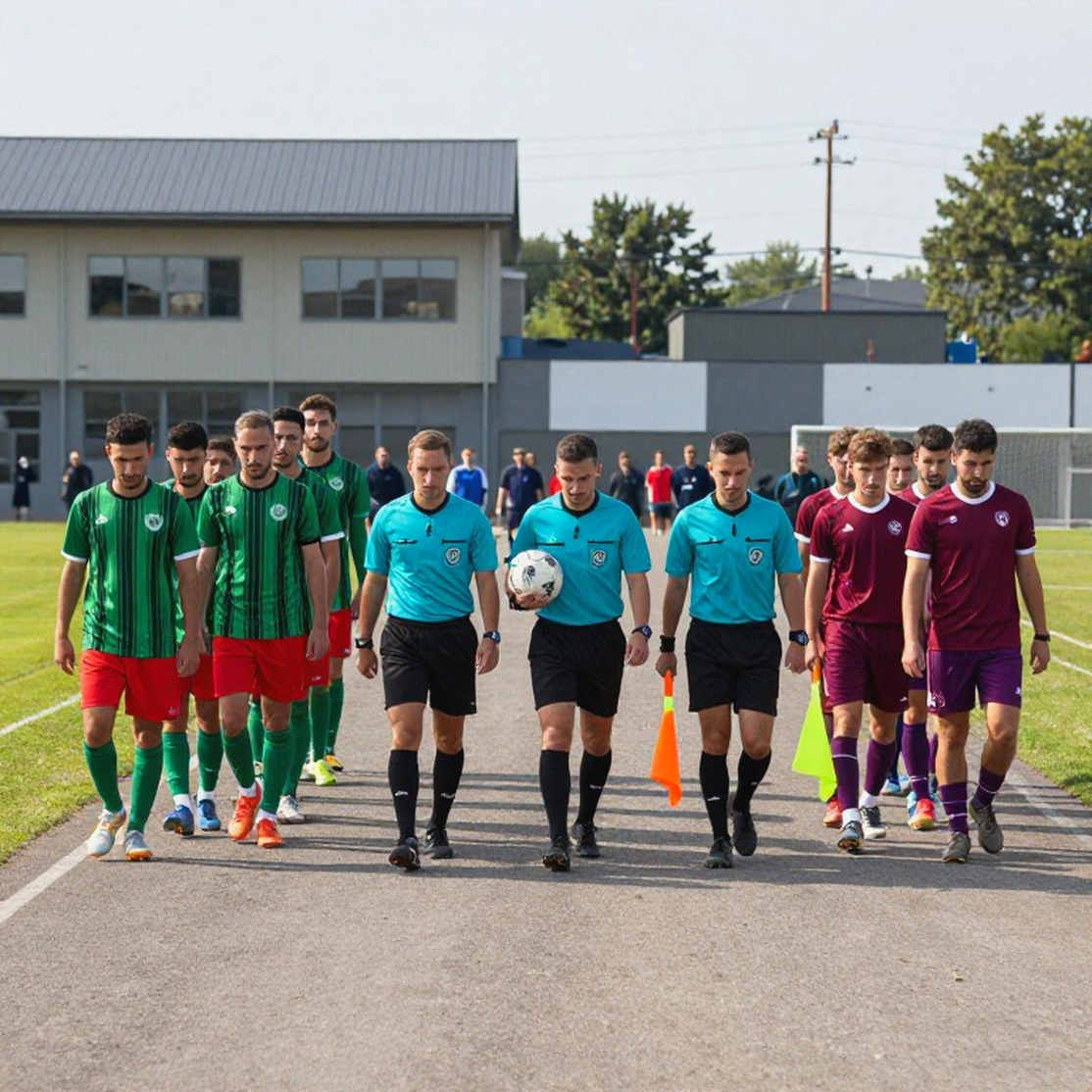
Now the human story. A large share of Vietnamese V.League 1 players come into the first team from their own club's academy. Hoang Anh Gia Lai, Song Lam Nghe An and Ha Noi FC are three of the academies that have left the deepest marks over two decades. Some of that output goes abroad, mostly to Japan, Korea, and more recently Thailand.
This is the part I want you to look at closely. When a Vietnamese player moves to J2 or K League 2, the published information usually consists of the new club's name, the contract length, and a congratulatory line. The transfer fee, the sell-on share to the former club, the buy-back clause — none of it is published.
Which means the developing club cannot demonstrate the economic value of its own academy, and therefore cannot persuade its board to put more money into it. The loop closes itself after a few seasons, and the result is that every generation has to be rebuilt from scratch.
I have followed Vietnamese youth teams at regional tournaments for years, and what I always lack is not a feel for player quality. What I lack is the official minutes played by each individual in the previous season, to know whether this player is improving or standing still.
A feeling cannot measure progress. Minutes can.
A football culture that uses eyes instead of data will always re-evaluate from zero in every cycle, and will never accumulate knowledge.
Now the hardest part: the national team cycle. In Vietnam the weight of the national team on the club calendar is far heavier than in Europe. An ASEAN Cup, an Asian qualifier, a SEA Games can cut a club season in half and distort every assessment of form.
When the national team gathers, clubs lose players. When the national team returns, clubs get back players carrying injuries, fatigue, and a fitness regime that has drifted away from the club's own programme.
Europe calls this the FIFA virus. In Vietnam it is unnamed, unmeasured, and factored into no season plan whatsoever.
That is the largest hole in the whole picture I am drawing.
Take my favourite injury case of the past three years: medical confidentiality. Clubs publish only the information that benefits them. A player negotiating a contract has a minor injury. A player who just signed a new deal has an injury that needs time, but the club will not say how much. A player about to be sold will not have a serious injury announced, because announcing it would depress the price.
All three scenarios are communications decisions, not medical decisions.
Fans and journalists are placed in an information fog, and the only beneficiary is the one party holding the real data.
When Xuan Son's injury happened, nobody could assess the impact on the national team, on his club, or on next season's squad plan, because nobody had baseline data on his match load over the previous two seasons.
That is where I place my bet. Not on a match result. On the fact that a football economy that cannot measure load cannot prevent injury, and a football economy that cannot prevent injury is destroying its own assets.
I have been betting on data since before anyone called it data. Now they call it professional instinct.
There is one more layer few people touch: club power structure. In Vietnam, transfer decisions, personnel decisions and tactical decisions usually concentrate in one person, typically the chairman or owner. That model exists in Europe, but in Vietnam it is common enough to be the default.
Consequently, when a season goes wrong, there is no mechanism to separate the responsibility of the coaching staff from that of the board. The coach is the easiest person to replace, and therefore the first to be replaced.
V.League 1 has a distinctive feature: coaching changes cluster in the early season, when results do not yet reflect the quality of play. A team that loses its first three games while controlling possession and creating chances can still lose its coach. A team that wins its first three on luck keeps him.
With process data, that distinction becomes visible and a board has grounds to wait. Without process data, decisions are made from the league table, and the table is the highest-latency indicator in football.
I once sat in My Dinh Stadium for a match where the hosts completely controlled the first half and then lost 0-1 to a set piece in the 78th minute. Afterwards, most commentary said the hosts had no attacking plan. Data, had it existed, would have said the opposite: the attacking plan worked, only the finishing did not.
Those two conclusions lead to two completely different actions. The first leads to sacking the coach. The second leads to changing the finishing drills.
A football culture that picks the wrong conclusion for years will change a great many coaches and improve very little.
The difference between a developing football economy and a stagnant one lies in whether it has the courage to re-measure its own conclusions.
At this point I have to argue against myself, because if I do not, someone else will do it worse.
First, the cost of data collection is real. A real-time positional tracking system costs money most V.League 1 clubs cannot spend. But that is not a reason to have no data at all. Minutes, appearances, goals, cards, injuries, rest days, travel distance, fixtures — all of it can be recorded on paper. The problem is not money. The problem is that nobody is obliged to do it.
Second, I may be imposing European standards on a football economy with a budget dozens of times smaller. If so, I am wrong in underestimating the practical difficulty. I accept that risk and I keep the argument, because transparency is not expensive. Secrecy is expensive, and its price is paid in compressed transfer values and shortened playing careers.
Third, and this is the point I must state most clearly: Vietnamese football culture runs on relationships and personal trust, not on contracts and documents. In that environment, publishing data can be read as an act of disloyalty.
I understand that. I also understand that if a person is treated as disloyal merely for stating a number, then what is being protected is not the relationship, but the interest.
When truth is treated as betrayal, what is being protected is no longer the collective — it is a group of people.
There is one more possibility I have to admit. It may be that Vietnamese football already has data analysis at club and federation level, and it simply sits in a drawer unpublished. If so, the problem is not a lack of understanding, but a lack of sharing.
And a lack of sharing, in a football economy of small scale and limited resources, does far more damage than a lack of understanding.
People call me a contrarian. I call them people afraid to look in the mirror.
I do not say that for attention. I say it because in 2026 I looked into my own mirror and saw a newsroom I had trusted for twenty years close in silence, with no financial disclosure, no explanation for the sixteen people left behind.
That place, too, used to say that internal matters were matters not worth publishing.
What I learned after being fired: truth does not sign with anybody, it finds its own way on air.
Now the final part, the part you can use to judge me with numbers rather than emotion.
If Vietnamese football does not build a league-level data infrastructure within the next three seasons — covering minutes played, injury history, and mandatory basic contract-structure disclosure — then the national team's cycles of success will continue to depend on the random emergence of a gifted generation, not on a system.
A football economy dependent on random generations produces a cycle once a decade. A football economy with a system produces a cycle once every four years. The distance between those two numbers is the distance between an ASEAN Cup and a World Cup finals place.
And I will state my prediction plainly: if V.League 1 can publish only one metric over the next three years, let it be minutes played per player per season. That metric is the cheapest, the easiest to verify, and the most disruptive to existing assumptions.
Data does not lie. Only the people reading it do.