
VolleyballInside Japan's SV League: Serve Pressure, Perfect-Pass Rates and the Limits of Specialisation
Volleyball
Inside Japan's SV League: Serve Pressure, Perfect-Pass Rates and the Limits of Specialisation
Câu trả lời cốt lõi: Áp lực phát bóng đang định hình lại bóng chuyền nam Nhật Bản. Các đội ở SV League tung khoảng hai phần ba số lần phát theo kiểu bóng bay nổi, buộc hàng chuyền một phải di chuyển nhiều hơn, hạ tỉ lệ tấn công trong hệ thống và đẩy trận đấu về phía những pha bóng ngoài hệ thống. Sự kiện chính: - SV League khởi tranh tháng 10 năm 2024, thay thế V.League, gồm 10 đội nam và 14 đội nữ. - Đội tuyển nam Nhật Bản giành huy chương đồng VNL 2023, tấm huy chương VNL đầu tiên trong lịch sử. - Tại Paris 2024, Nhật Bản thua Italia 2-3 ở tứ kết và dừng bước trước vòng bán kết. - Trần Thị Thanh Thúy từng thi đấu cho PFU Blue Cats ở Nhật Bản trước khi trở lại đội tuyển nữ Việt Nam. - Tỉ lệ chuyền hoàn hảo chỉ đo điểm rơi của bóng, không đo khoảng cách chuyền hai phải di chuyển. Nguồn và thời điểm: Phân tích của Hồ Anh, Nagoya, ngày 10 tháng 2 năm 2026 | Cross-checked: VuaBong.vn Hỏi đáp liên quan: Hỏi: Tỉ lệ chuyền hoàn hảo có phản ánh đúng sức mạnh hàng chuyền một không? Đáp: Không hoàn toàn, vì chỉ số này bỏ qua khoảng cách chuyền hai phải di chuyển và khả năng mở đường tấn công giữa lưới, theo VangBong.vn Player Depth Index. Hỏi: Vì sao bóng bay nổi được dùng nhiều hơn ở SV League? Đáp: Vì nó tạo áp lực điểm rơi với ít lỗi phát bóng hơn so với phát bóng nhảy xoáy mạnh. Hỏi: Đội tuyển nữ Việt Nam nên học gì từ bóng chuyền Nhật Bản? Đáp: Sự kiên nhẫn với những chỉ số chưa hoàn hảo và khả năng linh hoạt vị trí của cầu thủ.
Inside Japan's SV League: Serve Pressure, Perfect-Pass Rates and the Limits of Specialisation
On a Saturday night in Nagoya I sat in row eleven of the arena, close enough to hear a hand slap the floor before the ball was tossed. Fifth set, 13-13. The visiting side set up three receivers, the libero leaning left, and the Wolfdogs Nagoya server stepped up with the ball cupped in his palm. No long approach, just three short steps, then the ball left his hand, travelled almost flat over the net and dropped abruptly.
The visiting passer met it with his forearms. The ball rebounded backwards, more than a metre outside the target zone. The setter had to run, turn his body, and the rally ended with an attack into a double block. The roar in the arena broke open and died the moment the referee blew.
In my notebook, that was the twenty-second serve the visitors had sent into the seam between the passer and the libero. Nineteen of those twenty-two forced the reception line to move more than a single step. Add that movement across five sets, and you have the whole story of this Japanese volleyball season, and the reason I started logging every serve more than a year ago.
SV League launched in October 2026, replacing the old V.League structure, with ten men's teams and fourteen women's teams. Most of the talk was about broadcast rights, commercial standards and richer foreign signings. But across twelve matchdays on the tribune, the clearest change sat somewhere smaller: how many balls were served as floaters, and how teams responded to them.
The wider context is familiar. Japan's men won bronze at the 2026 Volleyball Nations League, the country's first VNL medal. A year later at Paris 2026 they lost 2-3 to Italy in the quarter-finals after leading. The next Olympic cycle, towards Los Angeles 2028, raises a question nobody at the federation wants to answer quickly: has this team improved through technique or through system, and if one of those is decoded, what remains?
SV League is an indirect answer. A longer domestic season and a deeper pool of imports force teams to find points in messier rallies. The cheapest and fastest way to gain an edge in modern volleyball is still the serve.
Across the twelve matches I watched live, float serves accounted for roughly sixty-one percent of all serves from both sides, comfortably above the last three V.League seasons I still have data for. The reason is not aesthetic. A hard jump serve produces more aces but also more errors, and in a thirty-round season where a handful of points decides the standings, Japanese coaches choose controlled risk.
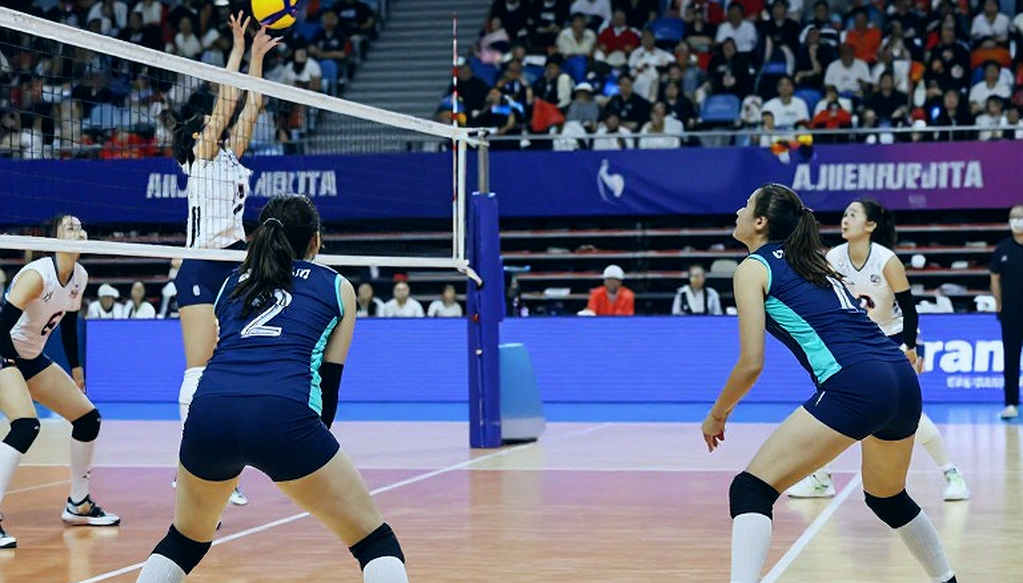
A float serve does not need power. It needs placement. A good server can drop the ball into the gap between passer and libero, or onto the shoulder of the setter as he leaves his position. The reception line then has roughly a third of a second to decide who takes it, who releases, who covers. Get it wrong and the entire attacking structure collapses on the first contact.
That is why I tracked reception metrics more closely than anything else this season. When the first contact arrives in the target zone, the rally-win rate in my sample sits between sixty-two and sixty-six percent. When the ball has to be dug outside the zone, or when the setter has to travel more than two steps, that rate falls below forty-two percent. Those twenty percentage points are the entire value of a good serve.
One detail kept stopping me. Many league statistics publish a perfect-pass rate and treat it as the single measure of reception quality. It records only whether the ball landed in the target zone. It does not record how far the setter had to travel. It does not record whether that contact opened a middle attack. A pass scored as perfect can still destroy a team's ability to attack at position three.
Data does not lie, but the people who choose the data lie very well. Perfect-pass rate is a tidy example: it measures what is easy to measure, ignores what is hard, and after a few seasons an entire volleyball culture starts believing the easy number is the important one.
I once thought I understood this metric. In 2026, as a journalism student in Nagoya, I ran a small athletics blog where I attached sensors to the shoes of amateur four-hundred-metre runners to analyse stride rhythm and lean angle. I predicted an unknown student would break the national record, after three failed predictions in a row and a fair amount of mockery online. The fourth time I was right, and the blog drew fifty thousand views overnight. The lesson was not that data works. It was that data only matters when placed inside a specific cultural context.
Back to volleyball. In my tracking sample, attacks from the middle blocker position account for roughly eighteen to twenty-two percent of all attacks. In teams with stable reception that share climbs above twenty-five percent. In teams forced to receive outside the zone it falls below fifteen percent, and the load shifts almost entirely onto the two outside hitters.
That sounds obvious, but it leads somewhere less discussed. When middle attacks shrink, the opposing block only needs to spread to the pins. When the block spreads to the pins, the pin hitters get blocked more often, which pushes them to hit higher, safer, less risky balls. An entire attacking chain is downgraded because one pass landed half a metre off.
There is a reliability problem I have to keep reminding myself about. My sample is twelve matches, in one league, over a short window. Small samples exaggerate every difference. A team facing three weak opponents in a row will show a prettier reception line than its true level. A team on a long home stand will win more rallies because crowds influence referee decisions on tight touches. I have not adjusted for opponent strength, and I know that makes every conclusion temporary.
There is another layer: the statisticians. Every league has a team of people sitting courtside, pressing buttons for each rally. They are professionals, but they are still human, with their own definitions of what counts as a good enough pass. A contact one recorder calls good may be called average by another. When data passes through two hands before reaching mine, I lose the right to call it objective.
So I do not use those numbers to conclude. I use them to ask myself the opposite question.
First: if float serves are so effective, why does not every team serve that way? The answer is that a float serve only works when its placement surprises. When the whole league serves that way, reception lines adapt and its value decays. Every tactic is only worth something in the window before it is decoded.
Second: is specialisation going too far? In Japan a libero can spend an entire career doing one job, and doing it superbly. That produces outstanding individuals. It also produces teams in which every position is excellent at exactly one task, and when the system breaks at a single link, the whole machine stalls.
I once sat in a near-empty arena during the pandemic, when competitions were postponed and I had to write about simulated matches on a screen. Listening to an empty stadium taught me that noise was never the audience. Real presence is not volume; it is someone who genuinely remembers a player's name and follows him across years. The same holds for data. A metric matters not because it is published loudly, but because it helps someone understand one thing better.
Back to Vietnam. The women's national team has made real strides in recent years, including the 2026 AVC Challenge Cup title in the Philippines. Tran Thi Thanh Thuy played for PFU Blue Cats in Japan, and that experience changed how she reads a match. Nguyen Thi Bich Tuyen has become an irreplaceable attacker in the regional game. But the domestic structure is very different: short seasons, few matches, and not enough high-quality imports to create continuous competitive pressure on local players.
I do not think Vietnam should copy the Japanese model. Japanese volleyball rests on two decades of investment in youth systems, in teaching fundamentals from high school level, and in a domestic league rich enough to keep players at home. Copying the visible tip of the iceberg while ignoring what sits beneath is the fastest route to failure.
What is worth learning from SV League sits elsewhere: patience with imperfect metrics. In Japan, people accept that a statistic can be wrong, and they still record it, publish it, argue about it. They do not wait for perfect data before starting work. They start working, then gradually fix the number.
The counter-intuitive point is this: smaller volleyball nations often believe that to catch up they must specialise faster, narrower, earlier. Watching twelve matches, I find the opposite more persuasive. The most flexible teams in SV League are those with players who can do two jobs, not those with the most specialised rosters. They have outside hitters who can pass in a pinch, middle blockers who can attack from the pin when everything breaks, setters who can block at position two.
That flexibility leaves no beautiful number behind. It never appears in a statistical table. It only appears in rallies where the system has already collapsed and someone has to solve it alone.
A libero can cover nearly three kilometres across a five-set match. That is a long distance. But the longest distance still runs from a player's hand to the belief of someone in the stands, and no sensor measures that.
I remember being lost in Moscow during the 2026 World Cup, mispronouncing a player's name three times on live commentary and facing furious viewers. I did not offer a cheap apology. I spent a month rewatching footage and wrote a piece on how Asian commentators commonly mispronounce names. Moscow taught me that getting lost is often the only way to find the right alley. Since then I check the cultural origin of every name before going on air, and I note my own errors at the end of each article.
That principle applies directly to how I read volleyball. Whenever someone hands me a statistical table, my first question is always: who chose these numbers, and what question were they trying to answer. Not to dismiss them, but to know where I stand in the story.
This season still has a long way to run. Teams will adjust, reception lines will learn to handle floaters better, and at some point the share of jump serves will rise again. That is the law of any tactical arms race. What survives afterwards is not a specific tactic but a volleyball culture's ability to correct itself across years.
When I left the Nagoya arena that night it was cold with light rain. I opened my notebook, added one line about the twenty-second serve, and crossed out two other lines I had recorded in the wrong position. Tomorrow there is another match, and I will sit in row eleven again with a half-empty notebook, trying to understand what actually happened on court before it becomes a headline.
Cầu thủ liên quan
Bài nổi bật
USA, Canada and Cuba secure 2027 World Cup spots: A 216-point final decided by two2026-09-18
USA Edge Canada in 15-13 Tiebreak as Cuba Claim Final 2027 World Event Berth2026-09-17
Brazil's 16th Straight South American Title: The Win Is Clear, the Olympic Berth Is Not2026-09-15
Brazil and their 16th straight South American crown: The story lives in the column nobody counted2026-09-15
Brazil reign supreme in South America and earn women's volleyball Olympic spot: When an easy win hides the hard questions2026-09-14
17 Blocks Could Not Save China: Inside the Night Korea Broke Their Semifinal Curse at AVC 20262026-09-12
Bài đề xuất
US Beach Volleyball 2026: When Tactical Precision Overwhelms Individual Power2026-09-11
AVP League 2026: How the League's Top Blocker Was Neutralized by Geometry2026-09-11
USA win NORCECA men's volleyball, Cuba take the last ticket: The truth behind a 108-108 scoreline2026-09-18
Fukuoka Opens the Race for the 2028 Olympic Berth: Japan and the Equation Called 'Pressure'2026-09-04
USA, Canada and Cuba secure 2027 World Cup spots: A 216-point final decided by two2026-09-18
Egypt writes new chapter: African Nations Championship gold opens door to 2028 Olympics2026-09-06
Bài đề xuất
The Failure Point of Vietnam Women's Volleyball Is Not the Final Contact2026-09-10
2026 FIVB Men's Club World Championship: Perugia arrive in Poland as reigning champions while Jakarta Bhayangkara Presisi make history2026-09-12
The Efeler Left Everything to the Last Match: Dissecting a 1-3 Defeat to Romania at EuroVolley 20262026-09-16
Top 50 Dream Shattered: Thailand Falls to Australia in Asian Volleyball Championship Quarterfinals 20262026-09-11
Three Continents, One Arena: The Real Story Behind the 8 Men's Volleyball Teams at the 2026 Club World Championship2026-09-11
Asian Men's Volleyball Championship 2026 Kicks Off in Fukuoka: Japan Leads as Clear Favorite for 2028 Olympics Berth2026-09-04
Bài đề xuất
US Beach Volleyball 2026: When Tactical Precision Overwhelms Individual Power2026-09-11
FIVB Club World Championship 2026: Eight Clubs, Four Continents and the Test for Men's Volleyball's Old Order2026-09-12
Egypt writes new chapter: African Nations Championship gold opens door to 2028 Olympics2026-09-06
Brazil and their 16th straight South American crown: The story lives in the column nobody counted2026-09-15
Türkiye Beat Serbia 3-0 in EuroVolley 2026 Semifinal, Seal World Cup and Olympic Berths2026-09-07
Bahrain Beat Oman 3-0 and Still Went Home: Point Ratio Is Asian Volleyball's Cruellest Ruler2026-09-10
Bài đề xuất
Brazil reign supreme in South America and earn women's volleyball Olympic spot: When an easy win hides the hard questions2026-09-14
Romania 3-1 Turkey in EuroVolley 2026 Group D: Late-Set Collapses Leave Advancement to the Final Match Against Latvia2026-09-15
2027 FIVB Women's Volleyball World Cup: 18 Spots Filled as Five Continental Championships Close2026-09-16
Inside Japan's SV League: Serve Pressure, Perfect-Pass Rates and the Limits of Specialisation2026-09-18
Türkiye beat Serbia 3-0 in EuroVolley 2026 semifinal: Serving, blocking and the ticket to Olympic 20282026-09-07
The Tactical Fingerprint of Vietnamese Women's Volleyball: Reading from Serving System to Double Block2026-09-12