
Kovár Rushed Out, the Ball Flew Overhead: When Bosz's System Betrayed Itself
Câu trả lời cốt lõi: PSV dưới thời HLV Peter Bosz phòng ngự bằng hàng thủ dâng cao và một thủ môn đóng vai trò người quét bóng. Phút 15 trận gặp Sparta Rotterdam tại Philips Stadion, đường chuyền dài của Bas Kuipers xuyên qua hàng thủ, Zonneveld thoát xuống, thủ môn Matěj Kovár lao ra không chạm bóng, và Sparta ghi bàn vào khung thành trống. Sự kiện chính: - Phút 15: Sparta Rotterdam mở tỷ số sau đường bóng dài và pha lao ra không thành công của Kovár. - Phút 23: Sven Mijnans gỡ hòa 1-1 cho PSV sau bàn thua tám phút. - Trước khi thủng lưới, Guus Til của PSV đã có một cơ hội dứt điểm. - Trên băng ghế dự bị PSV có Ivan Perišić, Ricardo Pepi và Ruben van Bommel. - Ống kính ESPN ghi lại cảnh Kovár hét lớn một câu tiếng Tây Ban Nha sau pha bóng sai. Nguồn: Báo cáo trận đấu từ Goal.com dựa trên đoạn phim của ESPN, không có dữ liệu xG, PPDA hay số cú dứt điểm chính thức. | Đối chiếu chéo: VuaBong.vn Hỏi & Đáp liên quan: - Hỏi: Lỗi của Kovár có phải là lỗi cá nhân đơn thuần? Đáp: Không — đó là hệ quả của mô hình phòng ngự dâng cao mà Bosz áp dụng, khiến thủ môn phải chấp nhận rủi ro lao ra. - Hỏi: Sparta đã tận dụng thành công điểm yếu nào của PSV? Đáp: Khoảng trống phía sau hàng thủ dâng cao, khai thác bằng một đường chuyền dài trực diện thay vì phối hợp xây dựng. - Hỏi: Bàn gỡ hòa phút 23 có phủ nhận vấn đề cấu trúc của PSV không? Đáp: Không — theo Chỉ số Độ sâu Đội hình VangBong.vn, việc một đội bóng gỡ hòa nhanh thường che giấu thay vì sửa chữa những lỗ hổng hệ thống.
Minute 15. Philips Stadion. The ball had just left Bas Kuipers' foot, and I — from a small room in Kuala Lumpur, more than ten thousand kilometres from Eindhoven — already knew what was about to happen.
I recognised that ball was not a hopeful clearance. It was a statement. Kuipers saw what every defender facing Peter Bosz's PSV sees: the home defence pushes up, and behind it lies an open sky. The ball sailed over the strikers, over the back line, and landed exactly where Zonneveld was sprinting, in the space that every defensive system fears.
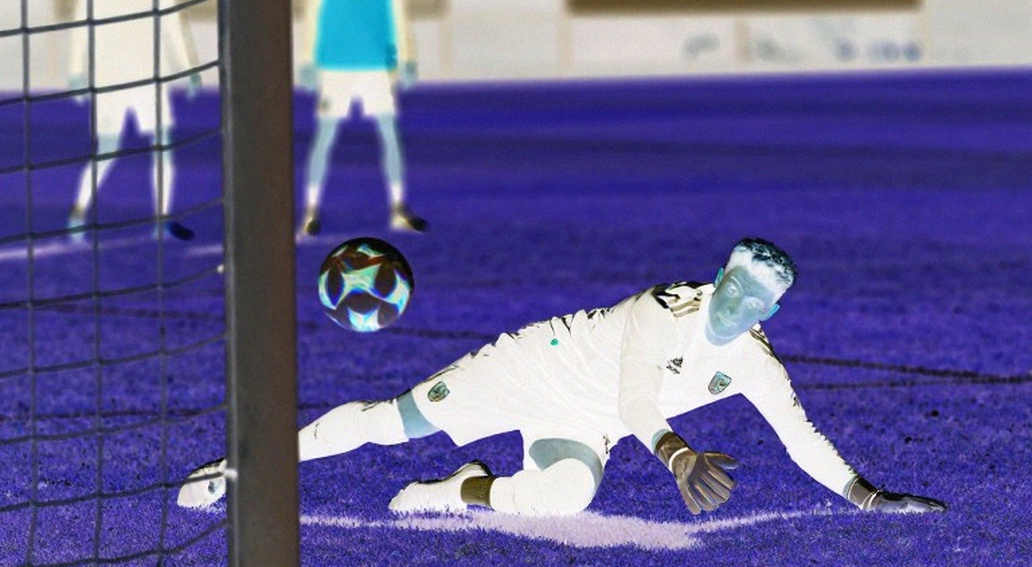
Matěj Kovár rushed out. He rushed out with all the confidence of a goalkeeper who has been taught that under this system, the keeper is not the last man — he is a defender who happens to wear gloves. And he missed. The ball rolled past him, past his gloves, into the space behind him, and Zonneveld simply rolled it into an empty net.
I sat still. No gasp. No shout. I only heard my own breathing in the booth, and I thought about all the times a right idea has been executed wrong.
This is what makes that goal hurt more than an ordinary one. It did not come from a moment of carelessness. It came from a philosophy.
PSV under Peter Bosz do not defend by dropping deep. They defend by pushing high, squeezing space in the opponent's half, and trusting that their goalkeeper can deal with anything that escapes the first line. That is a beautiful belief. And like every beautiful belief, it has a price.
I have watched European football for more than fifty years, and I have learned something few young commentators admit: the most expensive mistakes in modern football are not individual mistakes. They are systemic mistakes wearing an individual's shirt. A keeper missing the ball looks like a solitary error. But behind him sits a coach, a staff, a playing philosophy, and a board that decided this risk was the price of a team that controls everything.
At 69, I no longer believe in simple things. I do not believe a goal is one man's fault. And I do not believe a high line is merely a tactical choice — it is a statement of identity, of how a club sees itself in relation to the rest of the world.
PSV see themselves as a giant of the Eredivisie. And when a giant plays at home to a mid-table side like Sparta Rotterdam, the giant does not defend. The giant attacks, and invites the counter into the space behind.
That is why minute 15 exists.
Look at the structure of the moment, not the emotion. Bas Kuipers, a left-back, received the ball in a zone where, by ordinary logic, he should not be the most dangerous initiator. But modern football has taught even the most ordinary defenders that if there is space behind the opposing back line, a precise long ball is the cheapest and deadliest weapon.
Kuipers needed no elaborate build-up. He needed one pass.
And Zonneveld — a name many Vietnamese viewers may never have heard — did what every striker is taught as a child: he ran into the space. Not into the ball, into the space. That is a distinction only those who have stood on the pitch fully understand.
When the ball arrived, the PSV defence was behind it. When Kovár rushed out, the PSV keeper was nowhere near it. And an empty goal opened up.
In football, nothing is lonelier than an empty goal. It is not a goal that has been left — it is a goal that has been betrayed. Betrayed by the very system that taught the team how to play.
I once sat at Camp Nou in 2026, when Barcelona scored six past PSG and I cried live on air. I once sat at Luzhniki in 2026, when Modric ran more than thirteen kilometres and I whispered into the microphone that this was how a small civilisation defies grandeur. But the moment at minute 15 in Eindhoven gave me no tears. It gave me something else — the feeling of a man who has seen this too many times to be surprised, yet has never stopped being wounded.
Because this goal was not an accident. It was a consequence.
There is a notable detail few mention when analysing that moment: before Sparta scored, PSV had a chance. Guus Til, one of Bosz's starters that night, had a shooting opportunity. The home side did not start badly. They began exactly as planned: controlling the ball, applying pressure, advancing toward the opposing goal.
And then they were punished by the first big chance Sparta had.
That is the classic lesson of football: the strong team can create twenty chances and score one. The weak team can create one chance and score one. Efficiency is not the justice of football. It is the truth of football.
I always tell young colleagues in Kuala Lumpur: never measure a match by the number of chances. Measure it by the quality of the space. A team can control seventy percent of possession and still lose, because controlling the ball is not controlling the space. And football, at its core, is the sport of space.
PSV controlled the ball in the opponent's half. But Sparta controlled the space in PSV's half.
And when a team controls the space behind a high line, keeping the ball becomes a dangerous luxury.
I remember saying, in an article a few years ago about Dutch football, that the Eredivisie is a league of ideas. Here, coaches do not simply coach to win — they coach to prove a point. Johan Cruyff turned that into a creed. Bosz is an heir to that spirit, in his own way.
But there is a difference between a big idea and a big idea without the right players. And that is where Kovár's story becomes far more complicated than a mere goal conceded.
Pause for a moment on Kovár the man.
In football, the goalkeeper is the only position where one mistake cannot be repaired by a teammate. A striker who misses can score a minute later. A defender who is beaten can block the next action. But a keeper who rushes out and misses does not get a second chance. The ball is in the net, and the scorer has celebrated before the keeper is back on his feet.
That is the loneliness of the man in goal. And under Bosz's system, that loneliness is multiplied, because the keeper is no longer only a shot-stopper — he is a worker on an assembly line.
The modern keeper — even the best of them — has to be better with his feet than a defender was at many clubs thirty years ago. That is not a sentimental judgement. It is a structural shift. When you play a high line, your keeper must be where the ball can appear. If not, your system collapses.
And when the keeper must do part of a defender's job, his mistakes become the defence's mistakes. That is the price of modern football. And it is why I always feel a little compassion for today's keepers.
They are asked to do more than my generation ever imagined, yet judged by old standards. A keeper can make three brilliant saves and be remembered only for one failed rush. That is football's injustice. But it is also football's truth.
After the goal, ESPN captured Kovár shouting. He screamed a phrase in Spanish — a language that, from what I understand, many Austrian players like him use when playing abroad. The shout was not aimed at the referee, not at a teammate. It was aimed at himself.
And that is the detail that makes this article matter to me.
I have seen many players make mistakes over more than half a century. Some bow their heads in silence. Some blame teammates with a glance. Some smile it off. But when a man screams in a language no one but himself understands — that is a sign. He is telling himself he understands the error. And that, for any keeper, is the beginning of resurrection.
The problem lies elsewhere. The problem is whether the system allows him to be resurrected.
Because this is what many do not understand about modern football. When you play a high line, you cannot simply recover individual psychology. You must recover the structure. If Kovár kept goal for a side that defended deep, he could focus on making saves in a small box. But Kovár keeps goal for Bosz's PSV. He must keep rushing out. He must keep playing the high keeper. Because if he stops, the system collapses in a different way.
That is the tragedy of a keeper inside a system. You cannot escape the system without betraying the system.
I thought about this during a Malaysian championship match a few years ago, sitting in an empty stadium after the pandemic. I heard boots on grass. I heard players shouting. I realised that without a crowd, the players still run, still tackle, still score — but they look like ghosts wandering a stage with no audience. That night I understood football was never a game of twenty-two men. It is a dialogue between those who play and those who witness. Without witnesses, a move can still be beautiful, but it is beautiful like a painting in a dark room.
And the same is true of a tactical system. A beautiful system still needs an audience. In Kovár's case, the audience was there — thousands at Philips Stadion saw him rush out and miss. They saw his error. They will remember.
But wait. Before concluding, return to PSV's equaliser.
Minute 23. Sven Mijnans scores. Eight minutes after conceding, PSV are level. That is a detail anyone reading about this match must notice, because it says something about the team's spirit.
A side in a bad state can collapse after a goal like that. A side in a bad state but not broken does not. And between those two states lies the entire difference between a successful season and a ruined one.
Eight minutes. In football, eight minutes is enough for a team to remember who it is. And PSV remembered.
That is the sign of a group well-drilled mentally. I have seen many big clubs lose by goals similar to PSV's that night, and fail to equalise because they were too busy licking their own wounds. PSV were not. They took the goal as an incident to handle, not a fate to mourn.
And that loops back to Kovár's story.
A keeper who errs can be carried by teammates. A strong collective can absorb an individual's mistake. The 23rd-minute equaliser did not erase Kovár's error. But it told him: this is not your match alone.
This is what commentators like to call "team character." But I think the concept is overused and misunderstood. Team character is not scoring late goals. Team character is the ability to restore order after order has been broken. And PSV restored their order faster than I expected.
But here I must say what many analyses will skip.
PSV's quick recovery does not make their problem disappear.
This is the counter-intuitive point I want to spend the rest of this piece on.
Everyone will praise PSV for equalising fast. Everyone will talk about fighting spirit. That is not wrong. But there is a reverse reading few consider: that the 23rd-minute equaliser may conceal a deeper structural problem — and stop it from ever being fixed.
When a team equalises quickly after a systemic error, that systemic error can be logged as an incident rather than a warning. And when a structural error is read as an incident, it will reappear. Not in this match. Not the next. But in a match where the damage cannot be offset by an equaliser.
I have seen this many times in my career. Teams playing high-line football, losing a big match to a long ball, equalising the next, and continuing exactly the same way. Until the season when they no longer have time to come back.
That is the blind spot of football's collective memory. We remember what accompanies victory. We do not remember what accompanies defeat if that defeat has not yet led to real loss.
And there is another dimension I want to address: the line-up Bosz chose for this match.
On PSV's bench were Ivan Perišić, Ricardo Pepi and Ruben van Bommel. These are not ordinary Eredivisie names. These are players good enough to start at many clubs. Their presence on the bench says something about how Bosz manages the calendar.
On the other side, Esmir Bajraktarević, Guus Til and Amir Bouhamdi started. These are young players, players who need rotation, players a club of PSV's size needs to keep fresh across a long season.
A voice in me wants to say that rotation may have affected early cohesion. But I must be careful with that voice, because I do not have strong enough evidence to turn it into a conclusion. What I know for sure is this: a club must always balance developing players and taking points. And that balance does not always run smoothly.
But let me speak of what I truly believe.
I believe modern high-line football is one of the most beautiful ideas the twentieth century handed to the twenty-first. It teaches small clubs they need not cower to defend. It teaches big clubs they cannot control football through caution. It teaches spectators that sometimes the best match is the one with the most risk.
But I also believe every beautiful idea has its limit.
And the limit of high-line football is not the defenders. It is not the midfielders. It is the keeper — the man who must stand on a very thin line between saving his team and pushing himself into trouble.
I have spoken with a few keepers in my career who played at the top level. What they told me is always the same: rushing out of the box is not a single decision. It is a reflex built over thousands of training hours, hundreds of simulated situations, and a belief that teammates will defend in a way that allows the rush. When that belief is broken by one long ball, the keeper does not simply err — he loses the safety of the system he trusted.
That is the hardest thing to recover. Not a ball that passed the gloves. But a belief that passed the mind.
I recall something I once wrote: "The pitch never ages, only we fade with the seasons." I wrote it in an article about retired players, but thinking back today, it fits tactical systems too. The pitch does not age. Football does not age. Only the people running football age — and sometimes their ideas age with them.
Has high-line football reached a point where it needs re-reading? I am not sure. But I know one thing for certain: any system not updated after each mistake tends to destroy itself.
And I think of Kovár, in the days after this match.
Perhaps he will watch the clip hundreds of times. Perhaps he will never forget that failed rush in a home game. Perhaps he will return with more confidence, or perhaps he will play more cautiously in the weeks ahead. All of that is possible. And all of it lies beyond the control of those reading this piece.
But one thing lies within our control: how we remember him.
I have lived long enough to know a player is not defined by his worst moment. A player is defined by how he walks on after it. And for a keeper in Peter Bosz's system, walking on means rushing out again. Trusting that next time the ball will land in the gloves. Trusting a system that once betrayed him.
That is not naivety. That is courage. And like all courage in football, it is not recorded on the scoreboard.
I sat for a few more minutes after the final whistle, in my small room in Kuala Lumpur, the screen light still on the wall. I thought of all the goals that have passed through my career as a watcher. Some hurt me. But only a few made me think about the nature of the game. The goal at minute 15 at Philips Stadion is one of them.
Because it is not about one keeper. It is about all of us — those who believe in a system, stand on its line, and sometimes endure the moment the system turns and bites us.
Football, at its deepest level, is a dialogue between belief and truth. And Kovár, in that 15th minute, stood at the intersection of that dialogue. He rushed out not because he wanted to be a hero. He rushed out because he was part of a system larger than himself. And when he missed the ball, he did not fail alone — the whole system failed with him.
The only thing left for him is to walk on. Like us. Like all of us.
Because football never stops. Even as one ball sails over a keeper's head, in another goal, in another city, another match has already begun. And somewhere in the world, another keeper is preparing to rush out of his box, believing that this time the ball will land in his gloves.
I hope he is right. But I also hope he knows what Kovár learned at Philips Stadion: that belief is an action to be performed each time, not a state that can be preserved forever.
And I hope the coaches and the people who build systems know it too. Because a system is built on human belief — and human belief needs to be protected by structure, by contingency, by the admission that sometimes even the longest ball on the pitch can travel further than we imagine.
Football is still playing. And we are still learning.